How to Choose the Right Forged Carbon Sheet?
Choosing the right Forged Carbon Sheet begins with performance, not appearance. Its dark marbled surface can look flawless, yet visual quality says little about fiber distribution, void content, or load capacity. Forged carbon usually combines chopped carbon fibers with resin under compression molding. This process supports complex shapes and shorter production cycles.
Market data shows why the material attracts attention. MarketsandMarkets valued the global carbon-fiber market at approximately USD 4.2 billion in 2023. Its report projects growth to about USD 6.3 billion by 2028. Grand View Research also identifies automotive, aerospace, and sporting goods as major carbon-fiber demand sectors. These figures describe carbon fiber broadly, not Forged Carbon Sheet alone. That distinction matters.
Dr. Paolo Feraboli, a recognized composites researcher, has emphasized a practical principle: “The material must be designed for the load path.” This idea should guide every purchase. Ask about fiber length, resin system, sheet thickness, curing temperature, tensile strength, and impact performance. Request test data, not only photographs. A supplier should provide batch traceability and dimensional tolerances.
Small details affect the result. A 2-millimeter sheet may suit a trim panel, but it may fail under repeated structural loading. Temperature and moisture also change performance. Do not assume a premium price guarantees superior engineering. Sometimes, it does not.
This guide compares manufacturing methods, mechanical data, surface quality, machining behavior, and supplier reliability. It also examines a common weakness: published specifications may use different testing standards. Careful comparison is essential. The best Forged Carbon Sheet is the one that matches the actual load, environment, and production process.
Define Forged Carbon Sheet: Chopped Carbon Fiber in a Resin Matrix
How to Choose the Right Forged Carbon Sheet?
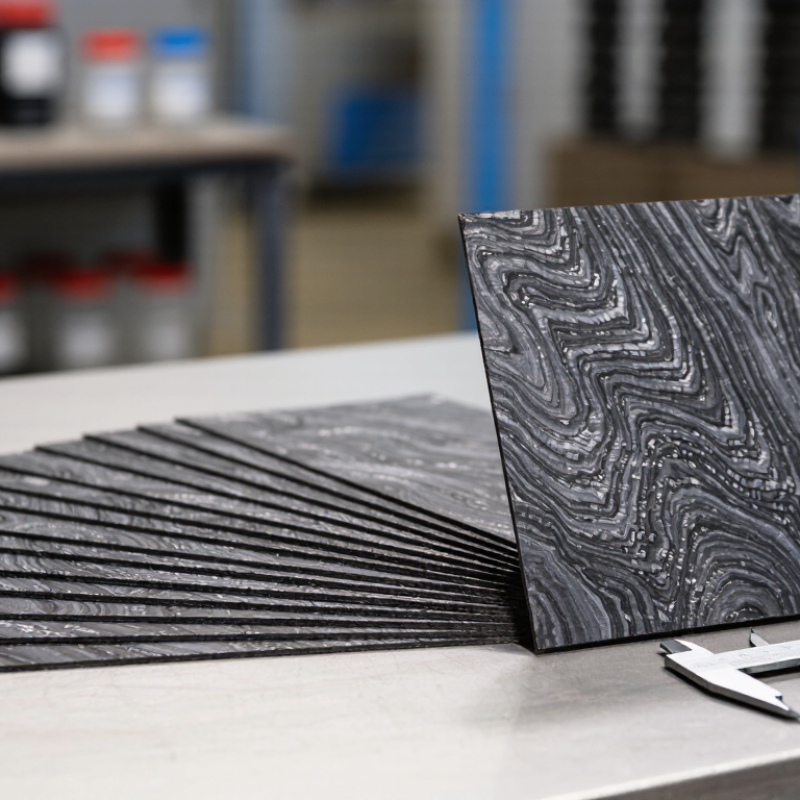
A forged carbon sheet is made from chopped carbon fiber suspended in a resin matrix. It is not woven. Short fiber pieces are distributed through the resin before compression molding. This process creates a dense sheet with a distinctive marbled appearance. Fiber directions vary, so the material can support loads from multiple angles. The result is often lighter than metal and more shapeable than traditional woven laminates.
Choosing the right sheet requires more than checking its surface pattern. Review the fiber type, average chop length, resin system, thickness tolerance, and measured void content. A glossy surface may look premium, but it cannot confirm internal quality. Ask for test data, batch traceability, curing conditions, and machining recommendations. These details show whether the supplier controls production consistently.
Consider the final part before selecting the sheet. Thin panels may suit covers, brackets, or trim, while thicker grades can provide greater stiffness. Check flatness, edge quality, impact needs, and operating temperature. Resin-rich areas can reduce performance and increase weight. No sheet is perfect. Small visual variations may be acceptable, but cracks, bubbles, or exposed fibers deserve closer inspection. In practice, the best choice balances verified performance, workable dimensions, appearance, and realistic production limits.
Compare Tensile Strength Using ASTM D3039 Data, Typically 500–1,000 MPa
When choosing forged carbon sheet, compare tensile strength under the same test conditions. ASTM D3039/D3039M measures composite tensile properties with controlled specimen geometry and loading. Reported values commonly range from 500 to 1,000 MPa for chopped or quasi-isotropic carbon sheets. Fiber direction matters greatly.
Technical benchmark tables in CMH-17-3F show higher strengths for aligned carbon/epoxy systems, often above 1,000 MPa. Forged sheets usually contain short, randomly oriented fibers, so their strength can drop near the lower end. Ask for specimen direction, thickness, resin content, curing method, and failure mode. Otherwise, the number lacks context.
A neat number can mislead.
In my experience reviewing composite certificates, two sheets may both claim 800 MPa yet perform differently in a drilled panel. Edge damage, voids, and uneven fiber distribution can reduce practical strength. ASTM D3039 results should include average strength, standard deviation, and test temperature. A reliable supplier should provide raw test data, not only a marketing range. I would also compare tensile modulus and elongation, because a strong sheet may fail suddenly with limited warning. My first selection can still be wrong if the test coupon does not represent the finished part.
Check Fiber Volume and Density: Common Targets Are 50–60% and 1.5–1.7 g/cm³
How to Choose the Right Forged Carbon Sheet?
Fiber volume and density reveal more than a polished surface. For many forged carbon sheets, a fiber volume of 50–60% is a practical target. Density commonly falls between 1.5 and 1.7 g/cm³. These ranges suggest a balanced relationship between reinforcement and resin. Do not trust appearance alone.
Ask the supplier for measured values from the actual production batch. A small sample should be weighed, measured, and tested under documented conditions. Compare the reported density with the material certificate, not only with a catalog range. Check the test method and sample location. Edge samples may contain different resin levels. Moisture can also affect weight slightly. That detail is easy to miss.
Numbers alone cannot confirm reliable performance. Inspect a cut edge for dry areas, resin-rich zones, or visible voids. An independent laboratory can verify fiber content through controlled burn-off or microscopic analysis, where suitable. In practical inspections, I have seen attractive sheets fail consistency checks because the center and edge differed. A panel may meet the target average while hiding local variation. Record thickness, batch number, and test conditions before comparing suppliers. Perfect uniformity is rare. A thoughtful buyer should question convenient data and request repeat testing when results seem unusually clean.
Verify Heat and Moisture Resistance Through Tg and ISO 527 Testing
How to Choose the Right Forged Carbon Sheet?
Verify Heat and Moisture Resistance Through Tg and ISO 527 Testing
A forged carbon sheet should be judged beyond its surface finish and fiber pattern. The glass transition temperature, or Tg, indicates when the polymer matrix begins losing stiffness. It does not define a safe operating temperature by itself. A sheet with a high Tg may still soften under long exposure, especially when moisture enters the matrix.
Moisture conditioning deserves careful attention. Test specimens in both dry and humid states, then compare their Tg values. Water can plasticize the resin and reduce dimensional stability. Small details matter. Record conditioning time, temperature, specimen thickness, and heating rate. Without these records, results become difficult to compare. I have seen promising samples fail because storage conditions were ignored.
ISO 527 tensile testing adds practical evidence. Measure tensile strength, modulus, and elongation before and after heat and moisture exposure. Retained strength often matters more than the original peak value. Use specimens cut from different sheet areas, because fiber alignment may vary. Test at room temperature and, when relevant, near the intended service temperature. A single test can mislead. Tg testing shows a transition, while ISO 527 reveals how the material actually carries load. The two methods should be reviewed together, with conditioning procedures clearly documented.
How to Choose the Right Forged Carbon Sheet?
Verify heat and moisture resistance through glass-transition temperature (Tg) and tensile testing according to ISO 527.
Higher Tg generally indicates better resistance to heat-related softening. The ISO 527 tensile results show how much mechanical strength is retained after moisture conditioning. For demanding applications, select a sheet with a high Tg and a small difference between dry and conditioned tensile strength.