- Home
- Products
- About Us
- News
- Blog
- Video
- Contact
Leave Your Message
Buying Carbon Fiber Composites can feel like choosing between identical black fabrics. They are not identical. Fiber grade, resin chemistry, weave, orientation, and curing method can change performance dramatically.
The International Energy Agency reported that global electric-car sales exceeded 17 million in 2024. That growth increases demand for lighter structures, battery enclosures, and durable components. The 2024 CompositesWorld State of the Industry review also identified transportation, aerospace, and wind energy as major composite markets. These figures show opportunity, but they do not make every carbon laminate a smart purchase.
Professor Stephen Hallett, a leading composite-structures researcher at the University of Bristol, has emphasized, “The right composite depends on the load, the process, and the application.” That principle should guide every quotation you request. A glossy panel may look premium, yet hidden voids, poor fiber alignment, or inconsistent resin content can weaken it. Ask for tensile, flexural, interlaminar, and impact data. Request cure records, batch traceability, and relevant certification.
Do not buy by price alone. Cheap material can become expensive after machining, rework, or premature failure. Also check tolerances. A panel that arrives three millimeters oversized may still be unusable for a tight enclosure.
There is no perfect specification.
These seven tips focus on practical judgment: defining loads, verifying supplier experience, comparing test methods, checking production consistency, evaluating sustainability claims, and planning the component’s complete service life. Some recommendations may seem obvious. They are often skipped. That is where purchasing decisions quietly go wrong.
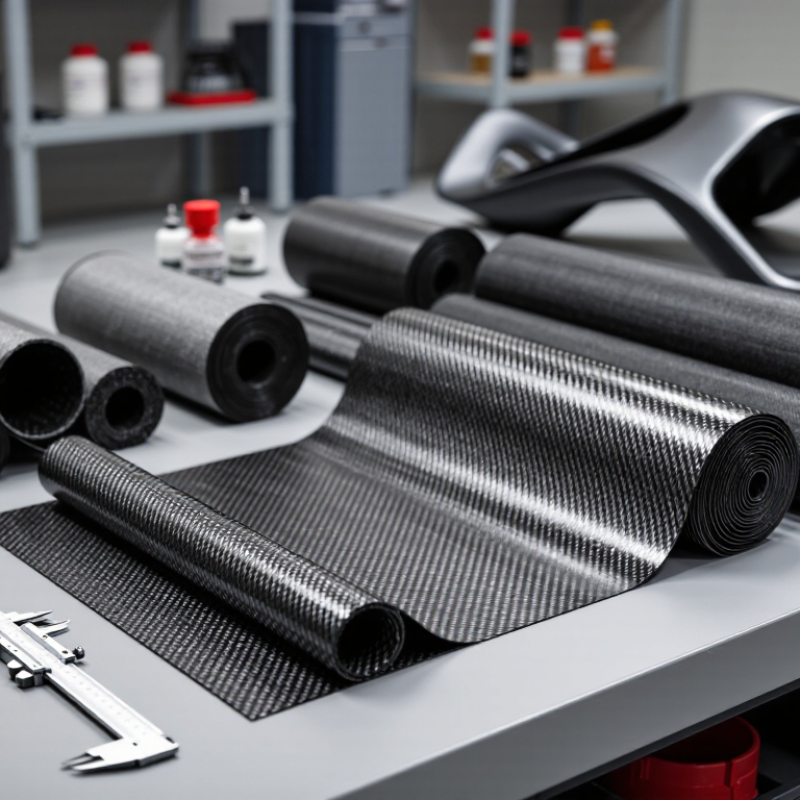
Carbon fiber composites are not one material. Unidirectional tape places most fibers along one load path. Woven fabric spreads strength across two directions, but adds crimp and slightly reduces stiffness. Chopped fiber compounds suit molded shapes and lower-cost production. Prepreg offers controlled resin content, yet requires careful storage and curing. The U.S. Department of Energy estimates that a 10% vehicle weight reduction can improve fuel economy by about 6–8%. That benefit depends on the complete structure, not fiber choice alone.
Tip: Ask for the fiber orientation, resin system, fiber volume fraction, and test method. A glossy surface proves little. Construction matters more. Designers may combine several 0°, 90°, and ±45° plies around a foam or honeycomb core. This creates a lightweight sandwich panel with strong bending resistance. Thermoset systems provide established processing routes, while thermoplastic composites can offer faster forming and improved repair potential. The International Organization for Standardization provides mechanical test methods, including ISO 14125 for fiber-reinforced plastics. Request test results that match your temperature, moisture, and loading conditions.
Tip: Inspect the edges and drilled holes. Poor consolidation can leave voids, resin-rich zones, or crushed fibers. These defects may remain invisible beneath a smooth finish. Industry assessments often place composite void content below 2% for demanding structural work, but acceptance limits vary by application. I have seen buyers focus on tensile strength and overlook fatigue, impact damage, and joining details. That is an expensive mistake. A lighter laminate can still fail early if the layup ignores real service loads. Tensile numbers are not the whole story.
| Tip | Composite Type or Construction | Fiber Architecture | Typical Fiber Volume Fraction | Directional Behavior | Advantages | Buying Checks | Common Applications |
|---|---|---|---|---|---|---|---|
| 1 | Choose Unidirectional (UD) Lamina | Most fibers run in one primary direction, with minimal transverse reinforcement. | Approximately 50–65% by volume in well-consolidated structural laminates. | Very high stiffness and strength along the fiber direction; comparatively weaker across the fibers. | Efficient for loads that follow a known axis and allows precise laminate design. | Confirm fiber direction, areal weight, resin system, cured thickness, and whether off-axis plies are included in the design. | Beams, spars, drive shafts, pressure vessels, and highly directional structural panels. |
| 2 | Consider Woven Fabrics for Multi-Directional Loads | Interlaced warp and weft yarns, commonly in balanced plain, twill, or satin constructions. | Approximately 45–60% by volume, depending on weave, resin content, and consolidation quality. | Provides reinforcement in two principal directions, but crimp in the yarns can reduce efficiency compared with straight UD fibers. | Good drape, handling convenience, and more balanced in-plane properties. | Check weave style, fabric weight, thickness per ply, yarn count, drape requirements, and whether the fabric is dry or resin-impregnated. | Equipment covers, vehicle panels, fairings, marine parts, and general-purpose laminates. |
| 3 | Use Chopped or Milled Fiber for Complex Shapes | Short carbon fibers dispersed in a thermoset or thermoplastic matrix, or deposited as a random mat. | Often lower or more variable than continuous-fiber laminates; the exact value depends strongly on the molding process. | Properties are relatively isotropic when fiber orientation is random, but usually lower than continuous-fiber reinforcement. | Suitable for intricate geometry, fast molding, and parts requiring less directional performance. | Ask for fiber length, orientation distribution, compound flow behavior, molding temperature, shrinkage, and mechanical test direction. | Small molded components, housings, brackets, tooling compounds, and electrically conductive parts. |
| 4 | Evaluate Prepreg Construction Carefully | Fibers are factory-impregnated with a controlled amount of partially cured resin. | Common structural prepregs are approximately 50–65% fiber by volume after cure. | Can deliver consistent, high-quality properties when the specified cure cycle and consolidation are followed. | Accurate resin content, clean handling, repeatable laminate quality, and low void potential. | Verify out-life, freezer storage requirements, cure temperature, pressure or vacuum requirements, shelf life, ply kit orientation, and cure documentation. | Performance structures, aerospace-style components, sporting goods, motorsport parts, and precision tooling. |
| 5 | Match the Laminate Layup to the Load | Multiple plies are arranged at selected angles such as 0°, ±45°, and 90°. | Often approximately 45–65% by volume for consolidated laminates, depending on the process and construction. | 0° plies carry axial loads, ±45° plies support shear and torsion, and 90° plies support transverse loads and stability. | A balanced and symmetric layup can improve dimensional stability and resistance to twisting or coupling effects. | Request the complete stacking sequence, ply orientations, cured thickness, symmetry, balance, and design allowables rather than only the surface appearance. | Frames, plates, tubes, brackets, torsion members, and load-bearing shells. |
| 6 | Check Sandwich Panel Construction | Thin carbon-fiber face sheets are bonded to a lightweight core such as foam or honeycomb. | Face-sheet fiber volume is typically specified separately; total panel fiber fraction is not a meaningful single value. | Face sheets carry in-plane tension and compression, while the core increases bending stiffness and carries transverse shear. | High bending stiffness-to-weight ratio and improved panel buckling resistance compared with a solid laminate of similar mass. | Confirm core density, core shear strength, face-sheet thickness, adhesive compatibility, edge close-outs, moisture resistance, and impact requirements. | Floor panels, doors, decks, fairings, vehicle interiors, and lightweight structural panels. |
| 7 | Compare Quality, Testing, and Process Data | Construction quality depends on fiber type, resin chemistry, consolidation, void content, cure control, and surface preparation. | For structural laminates, request the measured value and test method rather than relying only on a nominal percentage. | Measured performance can vary with fiber direction, specimen conditioning, temperature, moisture, and loading mode. | Traceable test data helps compare materials fairly and reduces the risk of selecting a visually attractive but unsuitable product. | Request certificates of analysis, tensile and flexural data, interlaminar shear data, void content, glass-transition temperature, batch traceability, and recommended processing parameters. | Any safety-critical, repeat-production, or engineering application requiring predictable performance. |
Note: The stated fiber-volume ranges are typical engineering ranges, not guaranteed values. Final performance depends on fiber grade, resin system, fiber orientation, void content, cure cycle, laminate thickness, environmental conditioning, and test standards.